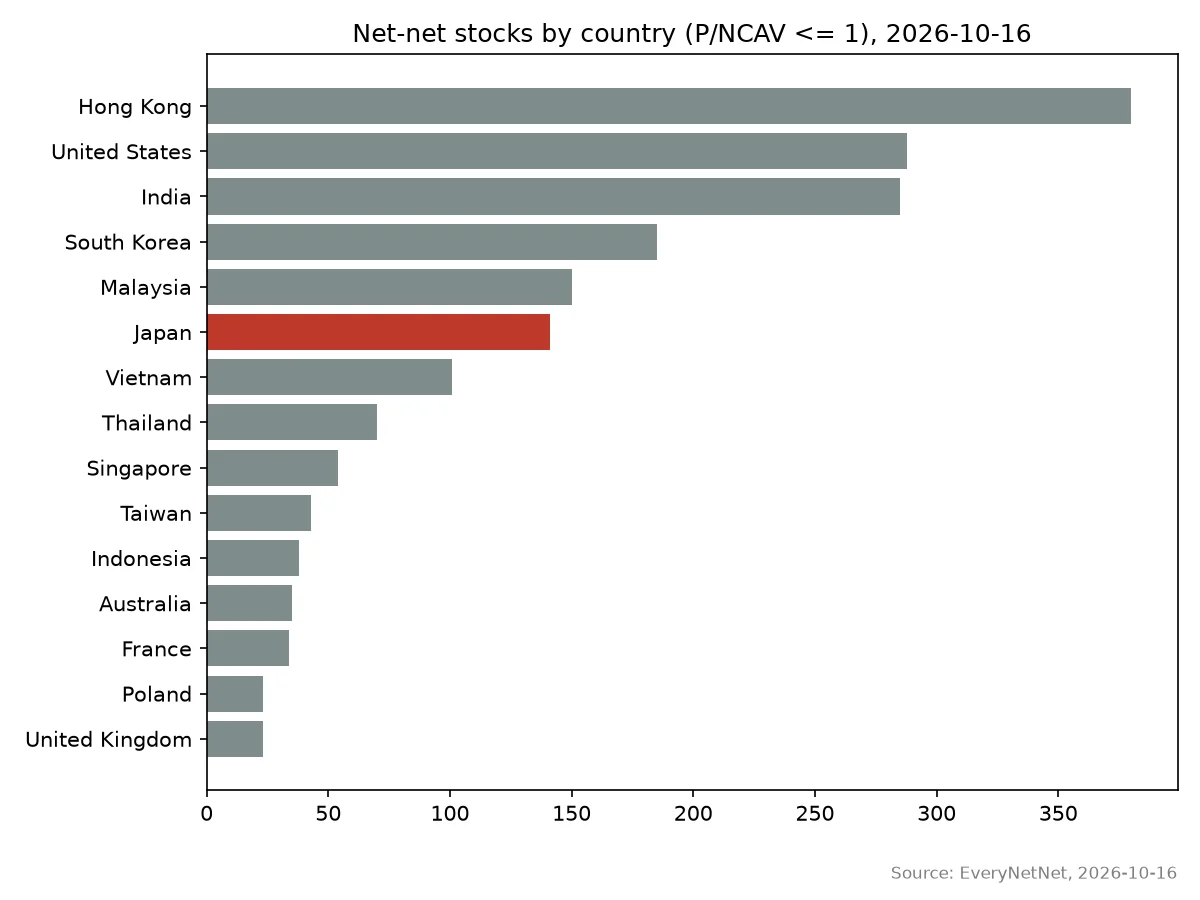
On October 16, 2026, 2,059 stocks in 61 countries traded at or below net current asset value. Hong Kong had the most, with 380. Japan, the market most people think of first, was sixth with 141.
This is the first of a monthly count. Same method every month, so the changes mean something.
The count
- Net-nets worldwide: 2,059, in 61 countries
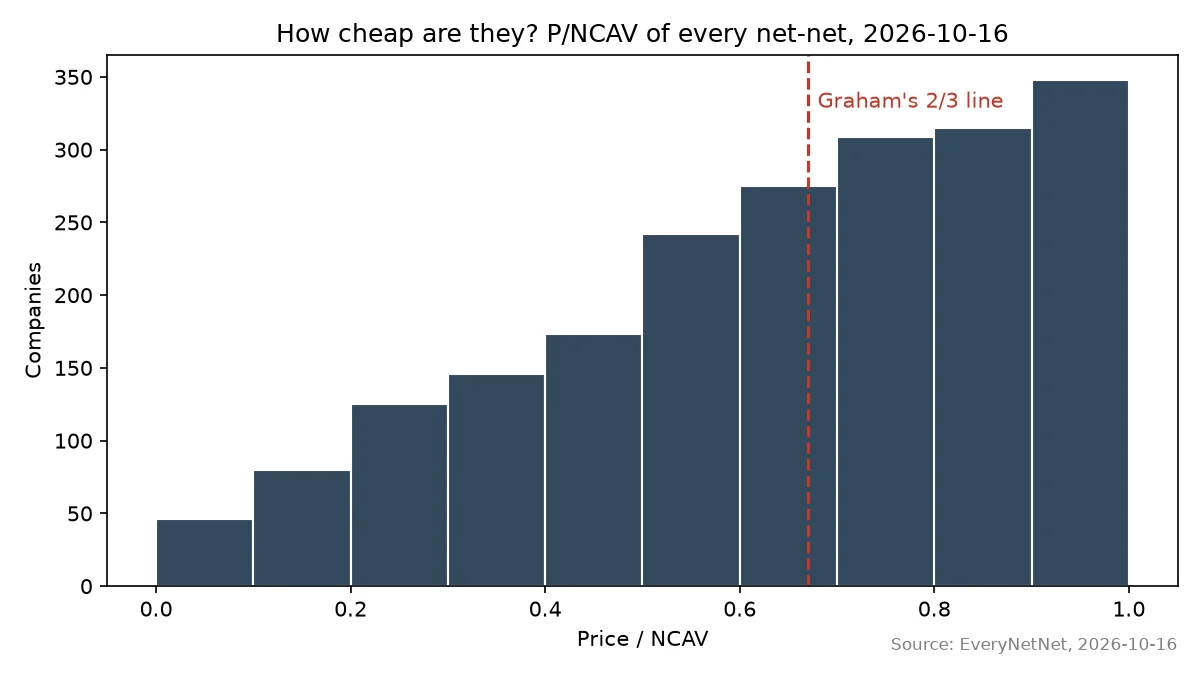
- Trading below two-thirds of NCAV, Graham's original buying line: 1,002 (49%)
- Top three countries: Hong Kong 380 (18%), the United States 288 (14%), India 285 (14%). Together they hold 46% of the list.
- Japan: 141 (7%)
In 2008 James Montier found around 175 net-nets worldwide, more than half of them Japanese. His screen was stricter and covered fewer markets than ours, so the totals don't compare. The mix is the interesting part: Japan has gone from most of the list to a small slice of it.
How we counted
NCAV is total current assets minus total liabilities, minority interest and preferred equity, from the latest reported balance sheet, converted to USD. A company makes the list when its P/NCAV is above 0 and at most 1. We drop companies under $1M in market cap and bankrupt (.Q) tickers. There is no liquidity filter beyond that. The full method is on our methodology page.
Balance sheets lag. A company's last filing can be months old, so some of these numbers will have moved by the time you read this.
Japan's count is down since July
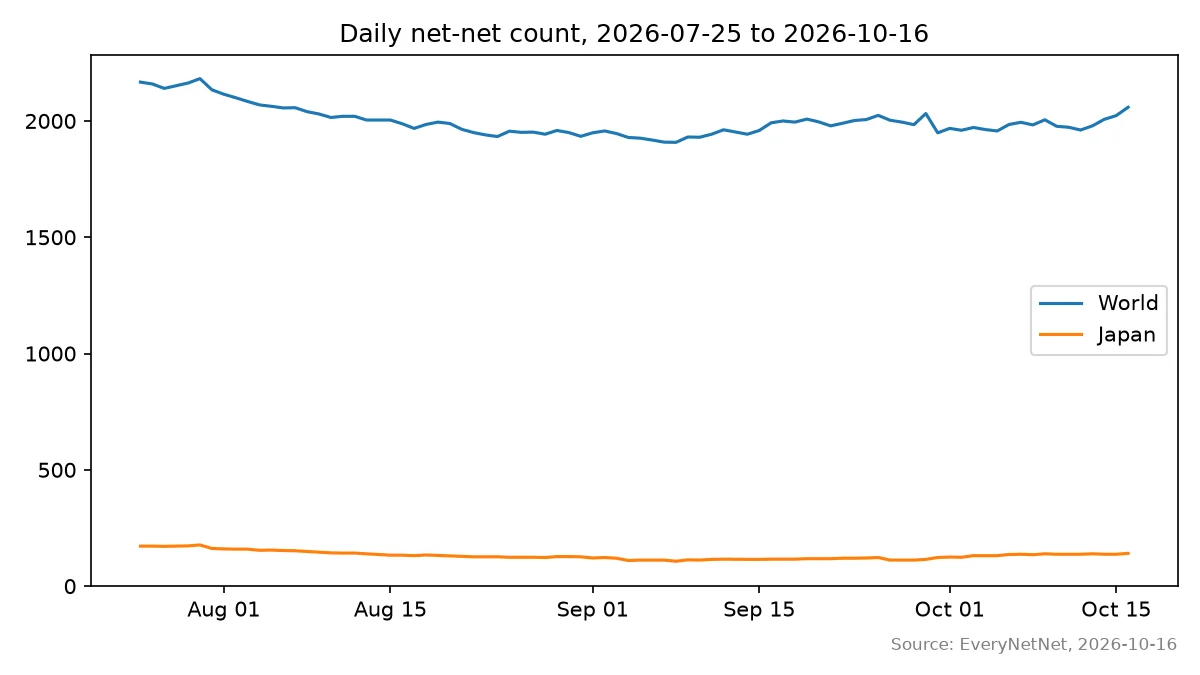
We started keeping a daily snapshot on July 25. That day Japan had 172 net-nets. On October 16 it had 141, down 18%, with a low of 107 on September 8. It has climbed back since that low. The world count fell much less over the same stretch, from 2,167 to 2,059 (5%).
Japan's net-nets are also the least deep of the big markets. Their median P/NCAV is 0.85, against 0.68 for the whole list. Since March 31, 2023 the Tokyo Stock Exchange has asked companies trading below book value to publish plans to fix it, and fewer Japanese stocks trading below NCAV is what you would expect if that pressure works. Three months of data is too short to say it does. Our Japan guide covers the background.
The rest of the world
After the top three come South Korea (185) and Malaysia (150), then Japan, Vietnam (101), Thailand (70), Singapore (54) and Taiwan (43). Asia outside Japan is where most of the list lives now. Europe is thin: France has 34, Poland 23 and the United Kingdom 23.
The US count is mostly small Nasdaq listings. Of the 288 US net-nets, 188 trade on the Nasdaq Capital Market and 32 on the OTC Pink market. US and Hong Kong net-nets are the cheapest of the big groups, both with a median P/NCAV of 0.55.
What a typical net-net looks like
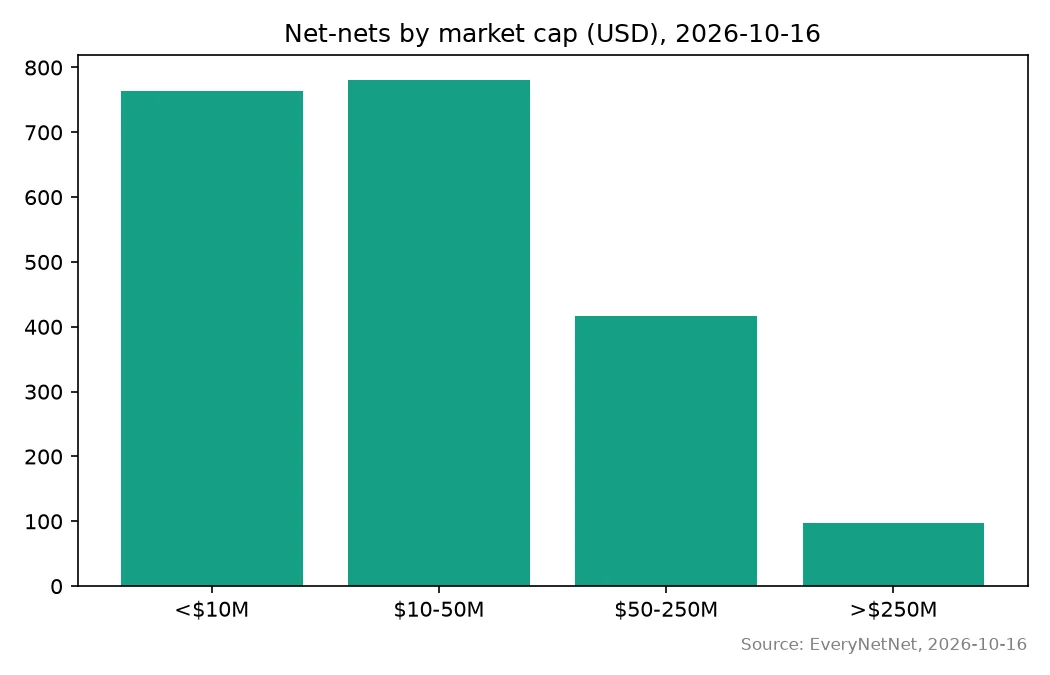
The median net-net has a market cap of $18.1M and trades at 0.68 times NCAV. Three in four are under $50M:
The P/NCAV spread leans toward the top of the range. Most companies on the list barely qualify, and the count thins out as the discount gets deeper:
By industry, real estate management and development leads with 197 companies, followed by textiles and apparel (133) and construction and engineering (117).
Caveats
A count is not a list of bargains. Most of these companies are tiny and thinly traded, some are losing money fast, and a few will be data errors. The cheapest names on the list, at P/NCAV under 0.02, are more likely to be bad data or companies in trouble than real bargains. If you spot an error, email support@everynetnet.com and we'll fix it. None of this is investment advice.
We plan to publish the next count in mid-November, from the same daily snapshots.
The full list is in Pro
These counts come from the same database Pro members search. Pro opens the companies behind them, with filters by country, industry and P/NCAV, for $10 a month.
See Today's Net-Nets